20 January 2022

ACTH

For once I’m not going to start with the poem this artwork is related to – in fact, I might not even include it at all in this post. We’ll find out by the end of the article, I guess…

You see, for one thing: it’s long. It takes up a whopping six pages in the current draft of Spectral, seven with the illustration. It’s the second longest piece in the book and will take up quite the chunk of time in the audiobook.

For another thing: it’s intense. And really, trust me – you don’t want to start your day reading that.

So I guess I’ll talk around it a little more while I decide. ACTH was written in November 2018. I couldn’t tell you what prompted me to write it – maybe I’d been waiting to write it for a while. It’s basically a (slightly) edited stream-of-consciousness about the process of not only having a panic attack or meltdown, but also how everything gets so much worse when someone is trying to get you to analyse and describe (and explain) your own feelings. Feelings which are huge and frankly monstrous, and out of your control but also very much a part of you.

If you’d like to back away from this post right now, no blame to you, fair play. At some point I’m going to have to turn it into a recording, and that’s going to be an interesting experience (I’ve only performed it three times or so, and each time I’m flushed and out of breath afterward).

This is not a comfortable or comforting poem (unless it helps you achieve a kind of catharsis, or merely makes you feel less alone, in which case I’m very glad for you), and it’s deliberately messy and difficult, as I take the stammer which deepens, when trapped in one of these spirals, into an ice-hot knot, an impossibly large glottal stop, and transcribe it over six pages of halting lines, some of which don’t even have letters in them, let alone words.

I wrote this poem in an Allographic Write-In, back when they took place in 3D space and hugs were a possibility. And it’s named as it is because I did my physiology and psychology degree back in the last century when we called serotonin 5-hydroxytryptamine (5-HT), and we learned about stress responses and the particular pathway governed by adrenocorticotropic hormone or ACTH, which I always get mixed up with acetylcholine, ironically enough. (Or maybe that was when I was teaching it to A Level students in 2003 and I had them act out the stress pathway by embodying different body parts passing notes to each other to stimulate other notes to be passed on to the next fidgeting organ… hard to say…) And titles are my least favourite part of the creative process, so a working title generally sticks around because it’s better than nothing. So behold: I Googled the hormones and neurotransmitters involved in a panic attack and discovered that there are a lot, including serotonin and dopamine (which surprise is part of the rationale for placing this piece at the end of the Anger section, which then leads into Joy), and we had a permanent working title.

Anyway, the thing about scribbling in a small notebook in a hurry when you have handwriting like mine is that all sorts of misapprehensions can occur, which led to this part:

… because I’m –carrying tigers
–t-ti– tight-wound into s-tubborn synapses;
I ssee them in the shape of certain smiles,
hear their growls in heavy footsteps, slammed doors,
all the other exhortations of a –twitching,
un– ttrustworthy world.

I couldn’t tell you now which word I misread as tigers, but I liked it, so on went the stanza into that extended metaphor.

When I was choosing illustrations for the book, I knew really early on that I wanted a tiger. Moreover, I wanted one moving through undergrowth, menacing the viewer.

Google image search brought something much more electrifying than my original, almost languid sketch (see end of post), but frustratingly, gave no clue as to the original photographer. Reddit, of all places, bounced me to the possible source, so, unless anyone knows any different, that’s who I’ll credit.
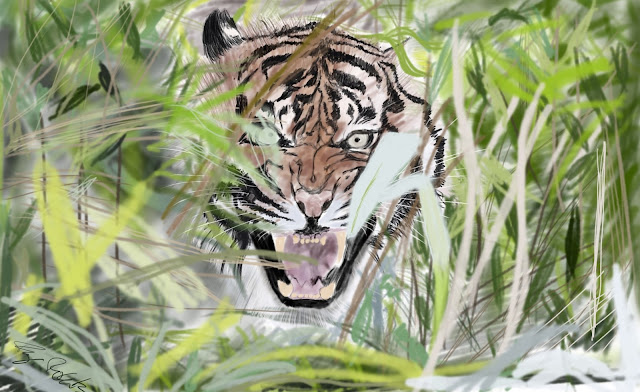
"Digital colour sketch of a tiger's face surrounded by abstract foliage. The tiger is snarling, mouth wide open, every tooth exposed, pupils pinprick-small. One ear is visible, and a hint of the other. Its eyes are a muddied shade of light green. The foliage that surrounds it are many shades of green and brown - blurred and scribbled, somewhat impressionistic, the leaves and stalks overlap the tiger's face, obscuring some parts and framing others. There is the tiniest hint of its massive body beyond. "
Source: Probably wildlife photographer Michael Nichols. One of the things that intrigues me is that I can’t tell whether this creature is exhibiting fear or rage. And that’s why it’s illustrating this poem…

There are fourteen visible layers to this piece (I may have overthought somewhat), plus another three for guidance, where I sketched the outline, and some of the important placements, like the stripes which seemed more significant to me at the time (and the more visible ear, which I apparently put in way too low, somehow). The learning curve for producing these has been steep, and this particular piece nearly saw me throwing the towel in; I’m really glad I persevered, even though it’s not quite as gloriously saturated as the Tyger of the glossy, childhood book I can still see, feel, and smell, with very little provocation. It’s possible that the publisher won’t be able to make much of the greyscale version of this; I’m looking forward to that discussion!

(And no, I didn’t know when choosing illustration concepts that 2022 was the Year of the Tiger… but I do now!)

Looks like I’m not giving you the whole poem this time after all. Instead, here is the concept sketch, complete with scribbly notes, and the initial outline of the final piece. Next time we’ll either be delving Philosophy & Mysticism, or Melancholy. Depends what I manage to do… Thanks for reading!
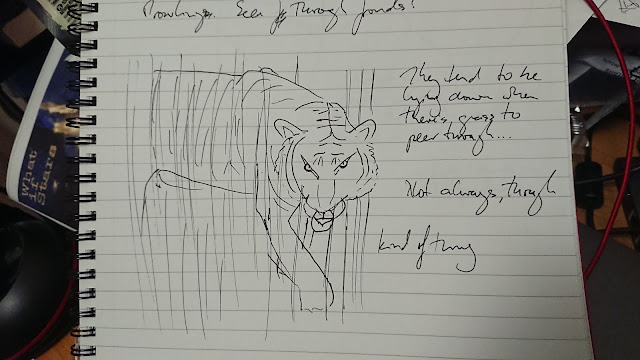
On lined paper in a spiral-bound notebook is a slightly cartoonish black ink pen sketch of a tiger prowling through vertical lines that are probably grasses. One paw is in front of the other and we can see as far as the start of its near hind leg. Its ears are pricked forward and is staring intently at something. Handwritten above the sketch are the words: "Prowling. Seen through fronds?" and at the side are further notes saying "They tend to be lying down when there's grass to peer through..." then "not always, though" and then the phrase "kind of thing" lower down. The pad is clearly on a very messy desk!
digital sketchy outline (incomplete) of a tiger's face - the tiger is snarling, mouth wide open, every tooth exposed, pupils pinprick-small.


17 January 2022

Meet Me In Marigolds

The Post-it note has a smiley face,
and it’s a race between emotions –
notionally: pleasure, beckoned by
the sight of your handwriting,
the way you fail to dot your every i.
‘There’s nothing else it could be!’
My smile stretches, sly and sweet.

Next: anticipation, a wave of adrenaline
spiking through the morning fugue
with images of rising to the challenge,
followed swiftly by the warm reward.

And then: contention bells in my head,
dread lurching to the fore;
for all the sweetness of imagination
there’s more, broadening the view of
victory to see us… where?

Are we in a field of fleshy flowers,
a barely-veiled metaphor dotting us
with pollen?
Hardly.
You’re neither hardy nor hearty,
usually eschewing outdoor pursuits,
pressing your suit in more… suitable locations…

Okay. Maybe we meet wreathed in blossoms,
top-heavy under some local post,
in-joke harking back to spy movies
and classified ads and brown-paper-wrapped
bad little habits in seaside retreats…?
Better.
But still not there yet.
Betting on landmarks seems foolhardy
in a city thronging with history.

This is a brutal test of my affections.

Next I consider: who am I missing?
Is this the name of one of your many associates?
Am I to approach a list of barely-retained
strangers to say: ‘Hey, is my… um… there today?’
stumbling and mumbling over names and titles,
bright with embarrassment and everything
we’ve never said?
You’re off your head, babe.
Hey, maybe we should call it a day?
This pressure’s getting heavy…

And then it hits me and I
dip my head, grin, slip to the sink,
rummage in its undercarriage and
come up golden.

Snap.

This is going to be one dirty weekend.

Back in late 2010, a poet named Tim Clare upped the ante on his annual poem-writing challenge, and set the stage to write 101 poems in a day. He asked for suggestions, and I ventured the title of this piece. He did it proud! I’m now the kind of person who runs poetry workshops, it turns out, and, when I’m faced with people who’ve done my standard prompt for a poem (“Lemons”, if you’re interested), I tell them: “Pick a book off the shelf and open it at a random page. That, or you could try ‘Meet Me in Marigolds’.” Very few have taken me up on that, sadly. By the time it got to late NaPoWriMo 2017, starting to run out of notions, I thought it was time I put my stanzas where my stylus is. Or something. Anyway, this is what happens when I’m being fussy about other people’s prompts - random story poems. It will be making an appearance in the Whimsy section of Spectral later this year.

A digital drawing of a pair of creased, long gloves which are coloured a bright yellow, lying on a rumpled, white surface, crossed at the wrists; there are some strong shadows under the gloves; the light is clearly streaming from the right, and there is a small, grey strip at the bottom of the picture, indicating that the gloves are overlapping the edge of the white, rumpled surface.

“Well, it won’t take long to draw this!” I thought. Feeling this especially true after I blasted so fast (for me) through drawing the kingfisher for Monarch. Oh well! It took me a long time to be happy with this one, and I think it’s pretty good now. Always difficult to tell, writing these so shortly after finishing drawing, when I’m still in the stage where I think it’s very flawed in every way. But the creases look better than anticipated in places, and I’ve decided that It Will Do.

13 January 2022

Monarch

There it is!
The branch startle,
the ice-pick dart,
the plunge and struggle.

There!
The sunset breast,
the test against gravity,
blue-muscled.

There! Oh, there!
Water spray light-caught,
fraught on a sleek line,
defining history.

You missed it.


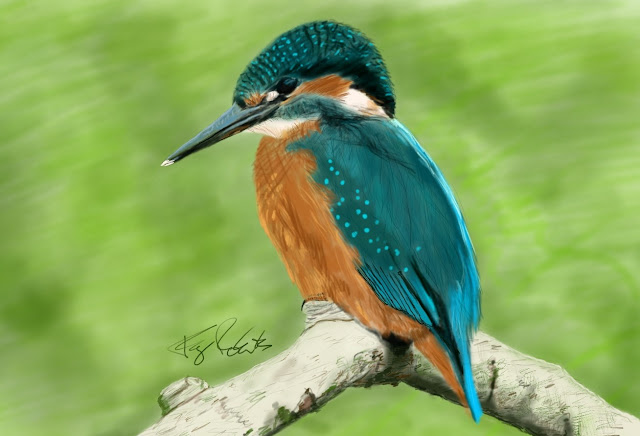
This piece was written in January 2017, and I honestly couldn’t tell you why. It’s been used by me as a quick piece for the Allographic open mic “Chaos Round” (where, for an unspecified amount of time an unspecified number of poets dash to the stage – physical or virtual – and give us tiny poems, fragments of pieces, mysterious fillips, then retreat) a few times, and, as they say, I just think it’s neat. As a child I did a lot of birdwatching, even had my own binoculars, and I’m still that person who’ll stop on a walk or stare out of a car window at interesting avifauna (sometimes to the consternation of the people in the passenger seats, it has to be said…). I have, however, never seen a kingfisher in person.

Mildly impressionistic digital drawing of a British kingfisher sitting on a branch against a fuzzy green background. The kingfisher squats on the pale, slightly knobbly, upward-curving branch, body in three-quarters profile, its back turned slightly toward us. Its head is turned to present a perfect profile, facing toward our left. Its dominant colour is a shade of teal - on its back, head, cheek, and tail, which is small and pointed. There are paler spots and highlights of aquamarine scattered throughout and curving along its back, and its head has an almost regimented variegation. The other main colour is orange - on its breast, belly, temple, and a little just in front of its glossy, black eye. There are white accents on the back of its neck, throat, and top of its long, straight, shiny, dark beak. One little taloned foot is visible peeking out from beneath the belly fuzz and curving around the knob of the branch on which the bird is perching.
A common kingfisher, drawn from a picture by John Bridges

This was a lot of fun to draw, but took me significantly longer to get around to starting than I’d have liked, probably because it seemed so very daunting a prospect to do justice to. However, once I’d got going, it took me significantly less time than anticipated to draw. I’m clearly learning… However, the source photo cropped the tail, so I’m very much hoping I did it justice!

Look out for this and its Lesser Spotted friends in Spectral later this year!

09 December 2021

Amber

You take my flesh in hand and start to score.
You press with gentle force to mark a seam.
You know the path, you’ve traced its route before:
this armour guards a softness, lush as dreams.

This task takes patience, time, and outright skill;
first layer gone and now the harder part:
a thin, tight membrane keeps you from your fill,
so lift the bitter, taste my sweeter heart.

The air sings, tartly, beckoning your tongue;
and busy fingers blush, juice running free.
Impediments are done, the feast’s begun;
my core surrendered, you devouring me.

The fresh scent lingers, memories kept real;
ripe flesh is worth the challenge of the peel.

This sonnet was written as part of #NaPoWriMo (National Poetry Writing Month) 2017. It's one of my traditions to try to write a #sonnet every April. This has since shifted as, 2019, I often write 7 sonnets every February, as part of the #28SonnetsLater challenge. You can see previous attempts of mine during NaPoWriMo on my dedicated blog. And this sketch is another colour piece! I'm clearly enjoying the challenge. Usually later in the process than with black-and-white sketches, it must be said... 

A mildy impressionistic digital drawing of a small orange sitting on a plain surface, utilising highly saturated colours. The peel on the front half of the orange has been peeled down to lie in three curving flaps; the rest of the peel remains around the orange, including a kind of cap of peel. The central segment of the orange has been pulled away to reveal the dark, hollow interior of the fruit, while the rest of the segments remain in place. A few drops of moisture cling to the top of the orange and within the open section. If one were a suggestible person, one might view the pointed, upright oval space with something firm yet juicy just drawing back from penetrating it in a rather sensual light. As it is, this merely an orange. Of course.
Ceci est seulement une orange

02 December 2021

Sentinel

The sky shifts over the
skirling hills,
the wilful wind sinks,
and my shadow
slips to drink.

You have discovered me
again, and my vows are
renewed –
memories echo in me
as you carry me home.

I am the beckoning,
tectonic,
pinning spirits
to now, from then
to ever.

Not for me the gorsedd –
eisteddwch,
tawelwch yn canu
;
listen and remember
under the bell of sunset.

I hide, unmoving shape-shifter,
one note in
the song of ever,
sipping from the sky
until you come again.

Sentinel is about the standing stone in the Brecon Beacons (a national park of rolling hills in South Wales) called Maen Llia. It’s said that the stone sometimes goes wandering down to the nearby river to drink at sunset... This piece was originally a commission for an elderly Welsh gentleman who came by our Poetry To Go stall at RHS Wisley’s Arts Festival and wanted a poem for this feature, describing in achingly evocative detail how the stone appears as if from nowhere when you walk the Beacons. The piece appears in the Nature/ The Sea section of Spectral next year.

a mildly impressionistic, full colour, digital drawing of a pink stone menhir - a rock roughly hewn into a teardrop shape - set against a rolling hillside. The stone is covered in lichen (white, yellow, and reddish-brown) and green moss, stained and cracked in various places. It is seated in a shallow depression, on top of a tiny mound. The grass in the depression is rather short, and there is longer standing grass encircling the dip. The stone casts a strong shadow behind itself, to the left of the viewer, and there is a strange, purplish pool at the foot of the stone's mound. The hill behind the stone shows a variety of dips and tracks as the ground undulates up to a pale, greyish-blue sky.
Another foray into colour. Not easy, this one, but I’m glad I persevered! I was particularly taken with how the paths and scars on the hill are echoed on the menhir at this angle.
Source image from Wikipedia: Photograph by Immanuel Giel

18 November 2021

Compound Rhythm

We have tried to fit you in,
lumbering you with familiar names,
shamelessly labelling you:
plodder, late-comer,
wobbly moss-beast.

Sky-divers, galaxy-striders,
depth-riders, you can leap
from sauna to ice bath,
without shrinking,
in the wink of an eye.

And foolishly, we write rules
that don’t apply to you,
radiating cool, defying filing,
to stride, pioneers hitching wagons
to a new star, taking the next slow,
sturdy steps into ubiquity.

14 October 2021

Clio of the Depths

I have cast off weight to glide,
lost light in the undersky.
Where my cousins plod,
I rainbow arc,
backlit swiftness,
sleek among the butterflies.

Close to grace, I open,
lotus-like,
a fine fruit,
toothsome,
its bruised flesh threshed
by my winnowing maw.

Gorged, I sheathe my
glass scimitars, and
weave into darkness,
seeking further sweetness.


This piece was written in October 2017, from an Allographic workshop about animal poetry with Robin Lamboll. Sea Angels are, essentially, marine snails that ditched their shells a long time ago to glide through the water with their "wings". (Well, sort of – read the Wikipedia article for more details...)

Look out for this and its Lesser Spotted friends in Spectral next year!

digital drawing of a sea angel - a translucent creature against a very dark blue background with an ovoid body and a set of six tentacle-like appendages curving out from around the centre of its head like particularly aggressive stamens. It has two disproportionately small, pointed "wings" either side of its neck which greatly resemble the collar of Doctor Strange's cloak. The creature is backlit so that all its edges glow, ranging from a mostly bluish body and wings, an orange bottom, and a yellow head. the tentacles range from very pale yellow to dark orange in colour. You know the creatures from the first season of Stranger Things? A bit like that. There is a faint signature in pale blue which reads "Fay Roberts".
I enjoyed drawing this - the first time I've used colours since I started drawing last year. Source image by Alexander Semenov.